Reflect & Discuss
Quick Check
Inquiry Task
Textual fragments can provide the framework of events, timelines, actors, and moral evaluations, but the perspective comes from the conquerors and tends to cast the conflict as a "rebellion—pacification" narrative. Physical remains can provide material-level comparison through siege works, settlement layout, and traces of daily life, but they usually cannot directly express the thoughts and self-understanding of those involved. The two types of material cannot substitute for each other; only cross-comparison can reduce the bias caused by a single source. At the same time, be aware that archaeological judgments carry inherent uncertainty, so wording should be cautious—do not present inference as established fact.
One can start with indirect clues such as survivals of local languages, place names and rituals, ways objects were used, and later retellings (for example, modern and contemporary literary and commemorative works) to see how the same event was narrated in different eras. The limitation is that these clues are often still transmitted through later linguistic and power frameworks and can only serve as indirect evidence. In analysis, it is necessary to clarify the levels of inference, clearly distinguishing "what the material shows," "reasonable inference," and "the researcher's interpretation."
In the mid-2nd century BCE, an unremarkable small hill town on the Iberian Peninsula called Numantia was home to local Celts who had thrown off Roman control. At the time, Rome was the undisputed master of the entire Mediterranean: it had defeated Macedon and the Seleucid Empire, conquered the proud Greek city-states, and reduced Carthage to smoldering ruins. Yet Numantia, which "had nothing but a love of freedom and a desolate homeland," repeatedly inflicted defeats on the Roman legions, forcing Roman armies to either surrender or retreat in disgrace.
In 134 BCE, Rome decided to send its most formidable general, Scipio Aemilianus (who had captured Carthage), with an army of over thirty thousand. He did not underestimate the fighting spirit and combat skills of the Numantians, and he also hoped to reduce unnecessary casualties among his soldiers. So he surrounded the city with reinforced defensive works, cutting it off from contact with the outside world, and madestarvationthe most powerful weapon. After more than a year, the Numantians ran out of food and set fire to their city; according to Roman accounts, most chose suicide and martyrdom rather than becoming Roman slaves.
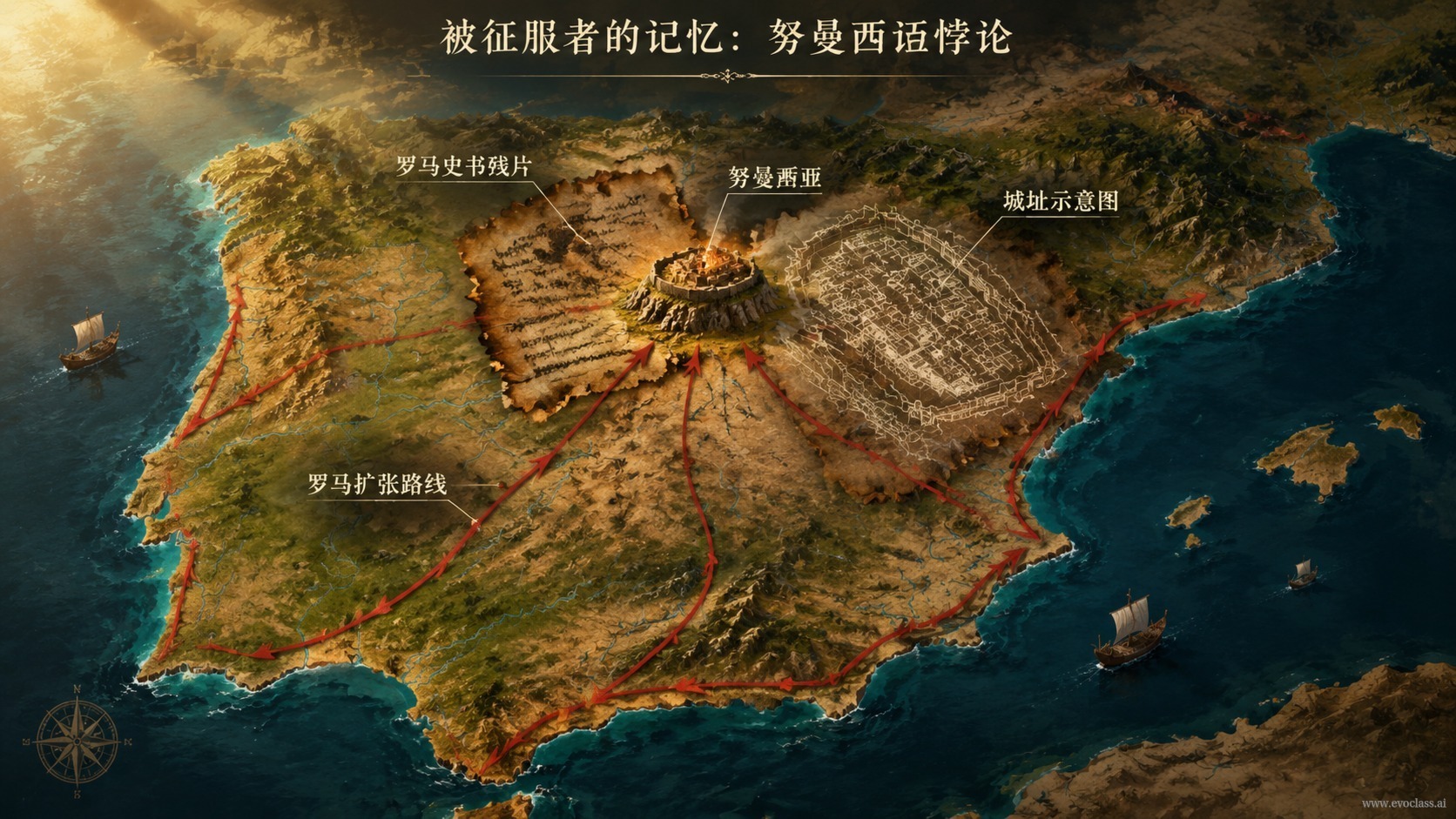
Regarding this resistance, siege, and destruction, later generations have relied mainly onRoman historians and Latin texts. The Numantians' own narrative never became part of mainstream historical tradition. Thus, "the conquered's memory" is often a form ofmediated memory: the defeated are preserved within the victors' language, categories, and moral frameworks, and the historical sources themselves carry a power asymmetry.
But this by no means equals saying Numantia "has no history." More precisely: its history was written, filtered, and repeatedly reinterpreted—this is precisely the core tension of imperial memory politics. A practical approach is to place texts and silent material evidence side by side: Roman histories show "how Rome narrated Numantia," while the remains of the city site and siege works provide another kind of silent contrast. The gap between the two is where the paradox lies.
Reading History Tip: When a period of history relies heavily on a single source, first ask three questions—who wrote the material, for whom it was preserved, and whose voices were filtered out.
The destruction of Numantia shows one face of empire: conquest by force, destroying local societies and local memories. But empire is not only this. After devastating conquest, Rome also gradually incorporated the conquered into its own order through legal dissemination, linguistic assimilation, institutional arrangements, and the expansion of citizenship. Cyrus's inclusive imperial ideal and China's concept of the "Mandate of Heaven" both provided justification for expansion in different ways and, to some extent, weakened the will of the conquered to resist—the former allowed conquered peoples to retain their religions and customs, while the latter interpreted the right to rule as an authorization that could be tested by virtue.
The gradual expansion of Roman citizenship, as well as cultural acculturation in the Arab and Chinese empires, all reveal the same process: new members are incorporated while continually striving for more equal status. From this we can see that what makes an empire an empire is not its origins, form of government, territorial size, or population scale, but rather how itintegrates multiple ethnic groups, and maintains rule and legitimacy in some manner.
Therefore, two common criticisms need to be examined separately. "Empires are necessarily inefficient" does not withstand historical scrutiny: empires often maintained long-term stability, and conquered peoples rarely succeeded in reviving—showing that their governance was effective over considerable periods. "Empires are necessarily immoral" is equally simplistic: the effectiveness of governance cannot erase the moral problem of conquest violence itself, but neither can it be used to deny all institutional and cultural exchange. Numantia later became a symbol of Spanish independence and courage, and Cervantes even wrote a tragedy ending with its destruction, The Siege of Numantia—the same memory is reinterpreted again and again by later generations.
The Conquered's Memory: The Numantia ParadoxObserve the map in the image, which marks Numantia's location and Rome's expansion routes, alongside fragments of Roman histories and a schematic of the city site. Think about how this relates to "accounts of Numantia come mainly from Roman historians and Latin texts."